
Everyone wants to use AI-generated writing. No one wants to receive it.
In 2026, the winner of a science photography prize was disqualified for using generative AI in his entry. The decision was made after complaints on the content organizer’s LinkedIn page that the winning entry seemed fake.
Before the accusations started flying and were eventually proven, the piece moved a panel of judges enough to vote for it. It probably beat out some outstanding competition. And those same judges were quick to point out that the disqualification was “not a judgement of the entrant’s professional reputation or scientific contributions.”
Instead, it was a line in the sand.

Looking for and calling out AI-generated writing has become a badge of honour.
We like the “I” in AI. We don’t like the “A.”
The intelligence piece is undeniable and goes beyond knowledge. Efficiency is an intelligence. So is capability. AI rocks in those two intelligence-based capacities and so many others. To say anything else would be folly.
It’s the artificial aspect that causes issues. We feel artificiality when we see it, as the photo contest’s first winner found out the hard way.
And we really feel it when we read it.
We hear everything we read in our own voice.
Informed by a lifetime of interacting with other human beings, we rebuild the content in our minds, see what’s being said through our own eyes and assign it a tone. For example, you could hear “Just Do It” at least three different ways depending on the voice in your head (JUST do it; Just DO it; Just do IT).
When you’re being spoken to by a robot trying to pass itself off as a human, you notice the foreignness of it. Something’s off.
That “something” was coined the uncanny valley in a landmark 1970 essay by Masahiro Mori, a Japanese roboticist at the Tokyo Institute of Technology. At the time, Japan was leading the global charge towards modernization and moving quickly. Mori’s essay served as a warning to those pushing the envelope to be mindful of what they were creating and take its users into consideration when deciding what to pursue, because the natural human reaction to a robot takeover isn’t what the robot creators would hope.
According to Mori, a robot is in the uncanny valley when it’s human enough to feel familiar but still fundamentally artificial, thus creating aversion in the human interacting with it.
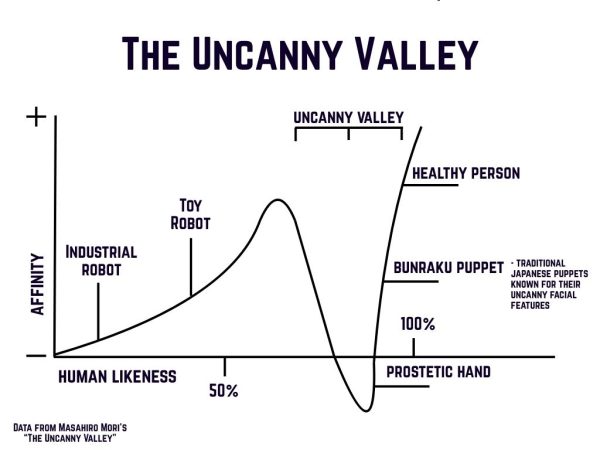
When we realize we’re reading AI, the aversion shows up as an eyeroll or a low-pitched “ugh.” It’s involuntary, like a low-grade fight-or-flight response. But since we have no one to fight, we choose flight. We stop reading and move on.
That’s part one of the impossible standard to meet. Part two is deeper.
The “writer” behind AI-generated writing can’t feel your humanity.
Fifty-odd years before Mori’s essay and roughly 9,500 kilometres away, an anthropologist posited a different explanation for the “something” we feel when we receive AI.
Marcel Mauss was known as the Father of French Ethnology, the branch of cultural anthropology focused on the comparative and analytical study of cultures. One of his more repeated assertions was the spirit of the gift.
Mauss saw the exchange of goods and services as more than transactional. When Person A relates to Person B on a human level, Person B is moved to reciprocate in a deeply human and almost cathartic way that transcends financial payment (even if financial payment is part of the exchange). This completes the gift exchange.
An example of this in action are the tears in an audience’s eyes when applauding the cast of a play after a performance. It’s a release of emotion triggered by the human spirit of the gift, which in this case would be the feelings evoked in the audience by the actors and the material. Yes, audience members paid their money before walking in. They happily pay again with their reaction.
On the flipside, the spirit of the gift is why cash never feels great to get as a present from a friend because it has no spirit and gives the recipient no emotional reason to reciprocate. But an inexpensive and fabulously perfect birthday gift from a friend that shows they love you is dripping with spirit. It’s a double-door opening to reciprocate, which you do by putting your heart into finding an equally personal gift for their birthday.
This “spirit of the gift” principle is also why the “like” button works so well on social media.
You don’t have to acknowledge a great article you read on LinkedIn; you could internalize the knowledge, put it into action and go about your day. But you’re moved to reciprocate by letting the author know that you read it, appreciated it and felt their spirit. And as a bonus, you do something you know will help them.
When you recognize AI-generated writing, you realize (consciously or otherwise) that it has no human spirit and its author can’t appreciate your reciprocal effort. The connection isn’t made. The emotion isn’t elicited. The proverbial tears in the audience can’t flow. It’s a net-neutral exchange, no different than receiving a spreadsheet. It is what it is.
If this was the human response to AI-generated writing, it probably wouldn’t be such a problem. But something interesting has happened: receiving AI-generated writing has come to feel like getting cash for your birthday.
When we receive AI-generated writing, we feel somewhere between mildly slighted and deeply disappointed.
It’s a different connection made, but definitely not the one the sender intended. The receiver feels like the sender doesn’t care about them enough to at least try to be authentic. It tarnishes the relationship. Even if what’s being said is correct or helpful or insightful, resonance will be almost impossible to achieve because no spirit has been exchanged. One side is wholly artificial and the other side knows it.
For AI-generated copywriting specifically, this causes a bigger problem because the point of copywriting is to create a connection that drives action resulting in a sale. If the copy creates aversion instead of connection, a sale is highly unlikely.
But we also feel torn by our own AI hypocrisy.
If the piece in question was art for art’s sake, like the science photograph or a book, then we’d be justified in our feelings because the creative process and the spirit of the gift is the entire point. Copywriting is not writing for writing’s sake. It’s writing for commerce.
In that case, we know why the sender used AI-generated writing. It’s the same reason anyone might use AI in their work: efficiency; speed; the releasing of effort that could be better directed elsewhere.
But it seems humanity is rejecting this use case in a collective fight-or-flight response that flips around the individual aversion to AI-generated writing discussed above.
Individually, we have no option to fight, so we choose flight. Societally, we have no option for flight (because AI-generated writing is everywhere), so we fight, sometimes by withholding our attention, other times by choosing to tag AI-generated writing as AI slop.
Neither AI nor our basic human instincts are going anywhere, so where’s the happy medium?
The happy medium for copywriting, brand messaging, content marketing and everything else that falls under the writing-for-commerce banner is to pick the spots for AI.
In an interview with The Globe and Mail, we compared the difference between human and AI copywriting to the difference between prefab and custom kitchens. Prefabs are great for rentals that need a kitchen, but you’d never put it in your forever home.
Brands and companies should split their marketing assets into two categories: rental property material and forever home material.
Forever home materials are the ones you know your ideal prospect will read, judge and consider when deciding whether to give you their money. Your website is forever home material. So are your pitch deck and any evergreen content. The majority of what you print on paper is forever home material because tactility creates the most intimate reading experience.
As for rental property materials, think of the single-serve ethereal pieces that disappear as quickly as they appeared. Filler social posts and blog posts to boost SEO could fall in this category. So could back-end meta copy. To be clear, you’d still be sacrificing quality, but it’s a trade-off you can afford for efficiency, speed and the releasing of effort that could be better directed elsewhere.
For your forever home materials, the uncanny valley and the spirit of the gift make the trade untenable. That’s where you want to move away from AI-generated writing and toward the human touch.
Consider the hybrid copywriting model.
AI is useful for collecting perspectives and mapping out structures into a starting point. And if you want to take it further, it will produce a perfectly fine first draft for you. But it can’t be the last draft, lest Mori and Mauss come back from the dead to knock on your door.
To be clear, there’s nothing wrong with getting AI to write a first draft. Getting somewhere with your content is better than being nowhere, and the relatively little effort will save you money. But it won’t save the copy from failing to transfer the spirit of the gift.
Passing your first draft off to professional wordsmiths will save it from the uncanny valley it’s currently in. They’ll inject the piece with gift-worthy human spirit. They’ll make you feel real. And they’ll help your material resonate with the real people you’re looking to convert into customers or clients in a way that AI simply cannot match because a human wordsmith has the one thing AI will never have, no matter how advanced it gets: humanity.
A challenge next time you realize you’re reading AI.
When you involuntarily roll your eyes or utter that “ugh,” see if you can figure out if it’s related to the uncanny valley or the spirit of the gift. In other words, are you icked out or turned off? It’ll be one of the two.